
In 2018, Seth Godin published a short piece with a title that feels even more relevant now than it did then:
“Mass personalization is a trap.”
His example was physical mail. A business creates something that looks handwritten, uses technology to imitate the intimacy of a personal note and hopes the recipient will mistake automation for care. The problem, Godin argued, is the uncomfortable moment when the recipient realises the intimacy was manufactured.
His final line was brutal:
“Humanity is too valuable to try to steal with a laser printer.”
Replace the laser printer with an AI model and you have a fairly accurate description of a lot of cold email in 2026.
"Saw your recent post on leadership..."
"Congrats on the funding..."
"Noticed you're hiring SDRs..."
"Loved your point about building culture..."
Then, almost without taking a breath:
"Anyway, we help businesses like yours generate more pipeline..."
The email contains something personal. Yet the message itself could have been sent to another 700 people.
That is the problem with cold email personalisation.
We have become remarkably good at proving we researched the buyer. We have become much less disciplined about asking whether the research actually changes what we have to say.
“Relevant, not merely personalised.
”
Your buyer is not marking your homework#
Imagine opening an email from a stranger and reading:
"Ben, I saw that OREE recently published an article about buying signals. Really interesting thoughts!"
You do not suddenly care about the next paragraph.
At best, the sender has demonstrated that they can use Google.
At worst, the compliment feels like the entrance fee you are being asked to pay before reaching the pitch.
Your prospect is not awarding marks for effort. They are making a much faster judgement:
Does this have anything to do with me?
That is why good B2B email personalisation is not primarily a writing technique. It is a relevance decision.
The detail you found should change your understanding of the account, the problem you lead with, the reason for contacting them now or the question you ask.
If it changes none of those things, it probably does not deserve the first sentence.
The inbox has an uncanny valley too#
We normally use the phrase "uncanny valley" to describe something artificial that looks almost human but not quite.
Cold email has one.
The message knows your first name. It knows where you work. It knows you started a new role in April. It knows your company recently announced an expansion.
Everything appears personal.
Yet somehow it feels less personal than a straightforward email from someone who simply understands your job.
This happens because personal data and personal relevance are not the same thing.
Consider these three openings to a fictional VP Sales.
Version 1: token personalisation#
Hi Rachel — noticed you're VP Sales at Acme. We help sales leaders improve outbound efficiency...
Nothing is technically wrong. Nothing has really been personalised either.
Version 2: research theatre#
Hi Rachel — saw your recent LinkedIn post about leadership and really liked your point about giving people ownership. It actually reminded me of what we're doing at...
The seller has done more work.
The buyer still has no better reason to care.
Version 3: commercial context#
Rachel — noticed Acme is adding SDRs alongside the move into Germany. When the target market changes at the same time as the team grows, keeping research and messaging consistent can become a different job entirely. How are you handling that across the team?
Now the research has a purpose.
The seller has connected two observable changes to a plausible commercial consequence, without pretending to know that the consequence is already a problem.
That is cold email personalisation worth doing.
There are four levels of personalisation. Only two really change the conversation.#
Not all personalised cold emails require the same amount of thinking.
| Level | What gets personalised | Example | Commercial value |
|---|---|---|---|
| Identity | Name, job title, company | "As VP Sales at Acme..." | Low |
| Individual | Posts, interests, career details | "Saw your post about coaching..." | Variable |
| Company context | Strategy, hiring, expansion, business changes | "Noticed Acme is building its SDR team..." | High when relevant |
| Commercial context | The connection between current context and a problem you genuinely solve | "As outbound expands into Germany, is keeping research consistent becoming harder?" | Highest when credible |
The first level helps an email avoid looking completely generic.
The second can create familiarity when the personal detail genuinely matters.
The third begins to show that you understand the buyer's world.
The fourth is where personalisation becomes commercially useful.
That distinction is not just opinion.
Gong Labs analysed more than 30,000 prospecting emails from more than 250 companies and found that the effectiveness of personalisation changed depending on who was being contacted.
For individual contributors and managers, Gong found that one-to-one individual personalisation more than doubled reply rates. For directors and above, individual-level personalisation produced a smaller uplift, while company-based topics performed substantially better.
That makes intuitive sense.
A CRO may be perfectly pleasant about your observation that they ran the London Marathon.
Their day is still dominated by the company.
Executives are people. Their priorities are usually bigger than their hobbies.#
This is where personalisation strategy often goes wrong.
Salespeople hear that they need to "make it personal", so they search for the most personal thing they can find.
University. Football team. Podcast appearance. Charity event. Holiday photograph. A comment on someone else's LinkedIn post.
Sometimes that creates a genuine connection.
Frequently, it creates an elaborate route around the thing the buyer is actually responsible for.
If you are emailing a Head of Sales, there is already plenty to work with.
How is the team structured? What market are they selling into? Is the commercial organisation changing? Has the company changed direction? Are new SDRs joining? Is the business moving upmarket? Is outbound founder-led or team-led? Are there signals that make a particular issue more relevant now?
These details are less "personal" in the traditional sense.
They are far more personal to the buyer's working day.
That is why sales email personalisation should usually start with responsibility before biography.
The best personalisation answers “so what?”#
Finding something about a prospect is easy.
Making it matter is harder.
Suppose your research shows that a SaaS company has three open SDR positions.
A weak personalisation workflow does this:
Fact: Three SDR vacancies.
Email:
"I noticed you're hiring three SDRs..."
Then the seller moves directly into the product pitch.
The reader is left to make the connection.
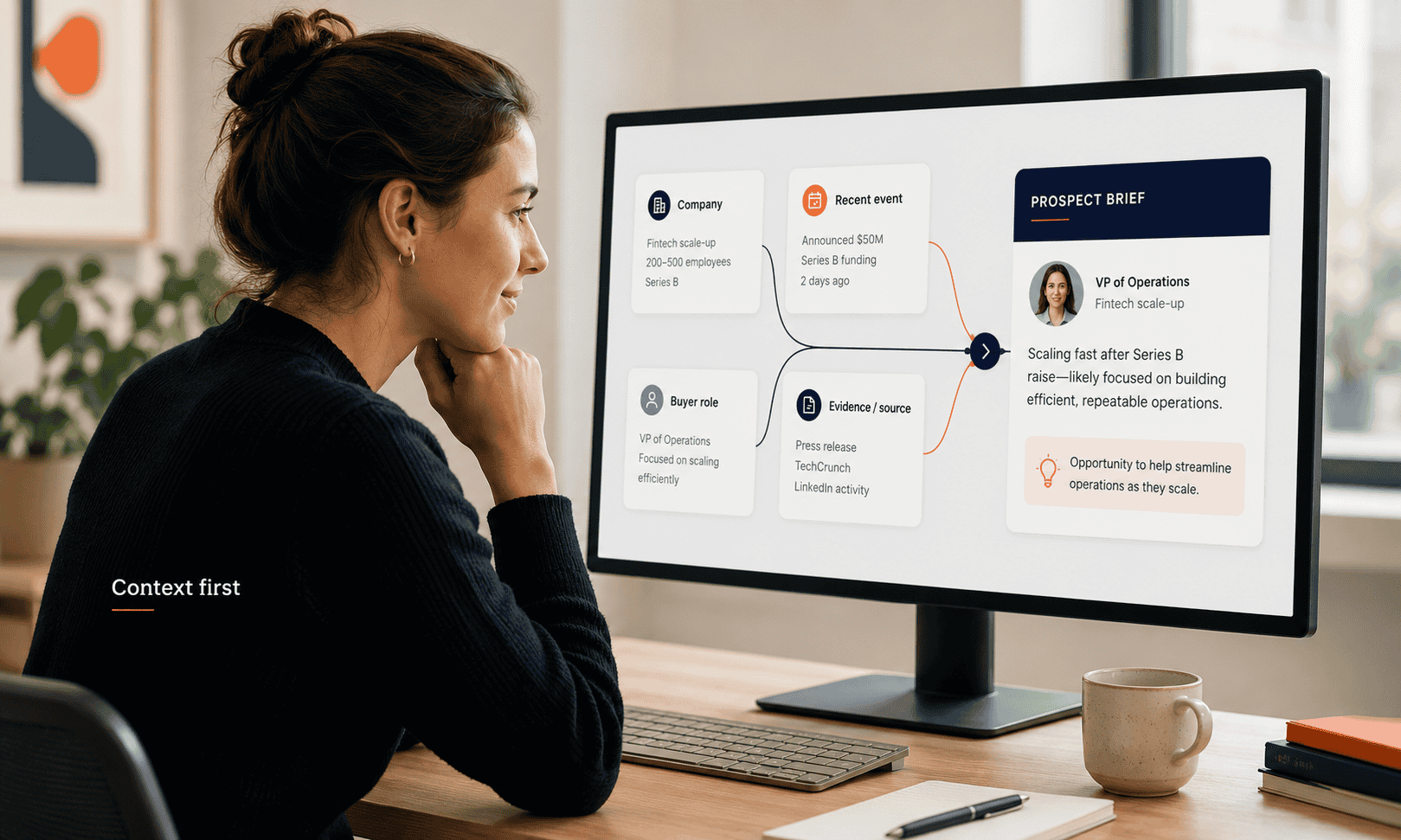
A stronger workflow goes one step further:
Fact: Three SDR vacancies.
Possible change: The outbound team may be growing.
Commercial consequence: More people may need to research, position and communicate consistently.
Relevant question: Is the current way of preparing outbound still workable as more people join?
The resulting email has a reason to exist.
This is the difference between using a fact and using context.
A cold email example: personalisation before and after#
Consider a fictional 75-person B2B SaaS company.
The company has recently announced entry into another European market and currently has several sales vacancies. We want to contact the Head of Sales.
Here is the version most people would call personalised:
Subject: Sales growth at Acme
Hi James,
I noticed Acme is expanding into France and you're currently hiring several salespeople — exciting times!
At OREE, we use AI to help B2B sales teams automate prospect research and create personalised email and LinkedIn outreach.
Would you be open to a 15-minute call next week?
There are two pieces of research in the first sentence.
The rest of the email ignores them.
Now compare it with:
Subject: outbound in France
James,
Saw the move into France alongside the sales hiring. When the market and the team change at the same time, the awkward bit is often keeping prospect research and messaging consistent without adding more prep to every rep's day.
Curious how you're handling that as the team grows?
The second email is not better because it contains more personalisation.
It actually contains less.
It is better because the context changes the conversation.
The buyer can immediately agree, disagree or say that the problem sits somewhere else.
That is useful.
Beware the compliment tax#
There is a particular cold email structure buyers have learned to recognise:
Compliment → segue → pitch.
"Loved the podcast."
"Great post."
"Congrats on the raise."
"Really impressive growth."
Then comes the real reason for the email.
The compliment is not always dishonest. But when it has no relationship to the commercial conversation, it starts to feel transactional.
You are effectively asking the buyer to accept a small piece of praise in exchange for tolerating the pitch.
Good personalisation does not require flattery.
Sometimes the strongest opening is simply an intelligent observation.
"You've added four SDR roles since moving into the US."
Then explain why that caught your attention.
No "exciting times".
No "huge congratulations".
No pretending you have been following their journey for years.
Professional buyers are perfectly capable of having a useful conversation without first being congratulated.
Gong's data reveals another uncomfortable point about automation#
Personalisation became attractive partly because automation made volume easy.
AI has now made personalised volume easy too.
That does not automatically make the resulting outreach better.
Gong's current Engage benchmarks, based on its 2024 data, report a 2.1% median reply rate for manual emails compared with 1.1% for automated emails sent through flows.
That does not prove manual writing itself caused the difference, and it certainly does not mean automation is inherently bad.
It does tell us something important: the ability to automate an email does not remove the quality problem.
The bottleneck has moved.
It used to be:
"Can we write enough personalised emails?"
Now it is:
"Can we create enough genuinely relevant emails without scaling bad judgement?"
That is a much more interesting problem.
AI makes personalisation cheap. Relevance is still expensive.#
An AI model can write:
"Congratulations on becoming VP Sales at Acme..."
for ten thousand people.
It can vary the wording.
It can mention a recent announcement.
It can analyse a LinkedIn post and manufacture a clever segue into your proposition.
The technical achievement is impressive.
The buyer still gets an email.
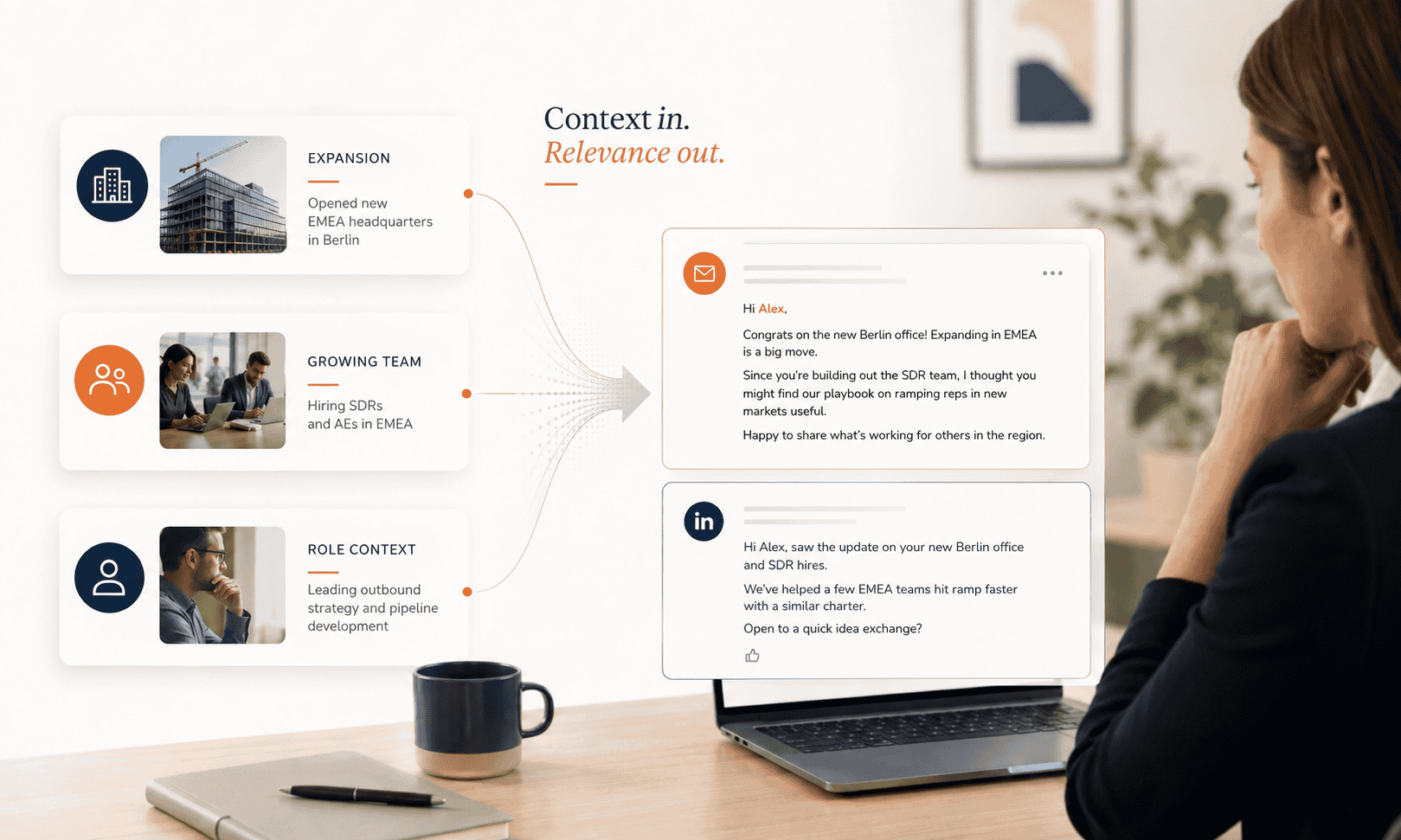
This is why AI email personalisation works best when the AI is given more than personal data.
It needs to understand the target customer, the buyer's role, the campaign objective, the seller's value proposition, the evidence available about this particular account and which claims it is allowed to make.
Then it can prepare something commercially useful.
Without that context, AI is simply an extremely productive sentence generator.
That figure should make every sales leader slightly uncomfortable.
The industry has spent years improving the ability to personalise.
Buyers are still asking us to be more relevant.
Personalise the reason, not every sentence#
There is another trap.
Once teams decide personalisation is important, they start trying to personalise everything.
The opener is personalised. The problem statement is personalised. The proof is personalised. The CTA is personalised. The follow-up references another new detail because apparently the prospect needs fresh evidence that the SDR owns a browser.
You do not need that much.
A strong cold email can often be built around one genuinely relevant piece of context.
The rest of the message should simply make sense.
A useful structure is:
1. Context#
What have you observed that materially affects this account or buyer?
2. Consequence#
What might that change mean for an area you understand?
3. Relevance#
Why is that consequence connected to a problem you can credibly help with?
4. Invitation#
Give the buyer an easy way to confirm, reject or explore the hypothesis.
The skill is not making every sentence unique.
It is making the reason for the email specific.
Sometimes the right amount of personalisation is none#
This is worth saying because automation encourages us to find something for everyone.
Sometimes the research produces nothing useful.
The prospect fits your ICP. They have the right role. The proposition is relevant. But there is no meaningful trigger, company change or individual context that improves the message.
Do not force one.
A clear role-based email can be better than personalisation theatre.
For example:
Sarah,
Heads of Sales I speak to rarely have a shortage of contacts. The slower part is usually everything between finding the account and having something credible for an SDR to say.
How much of that research and message prep still sits with the reps at Acme?
There is no reference to Sarah's marathon.
No funding announcement.
No LinkedIn stalking.
The relevance comes from the problem and the role.
A prospect would rather receive an intelligent generic observation than an irrelevant personalised one.
What should you actually measure?#
Do not judge personalisation by whether the field populated correctly.
And be careful with open rates. Privacy protections, image loading and automated security scanning have made opens increasingly unreliable as a proxy for genuine buyer attention.
The better questions sit further down the conversation.
Are the right people replying? Are replies relevant to the proposition? Are positive replies turning into conversations? Are certain research angles consistently rejected? Are SDRs heavily rewriting AI-generated messages before approval? Are particular types of context producing better conversations than others?
Your team is trying to learn what makes buyers care.
That is a commercial question, not a mail-merge question.
Where OREE fits#
OREE is an AI-assisted outbound sales platform built around the work between identifying a prospect and starting a useful sales conversation.
Prospect and company research is Live. Personalised first-touch and follow-up email generation is Live, as are coordinated email sequences. OREE can also prepare LinkedIn outreach, bringing the available context and messaging into the same human-controlled workflow.
The important part is what happens before the draft.
OREE can structure available prospect and company context and connect it to the campaign's approved value proposition before preparing the outreach. The message can then be reviewed by a person before it represents the business.
That is deliberate.
The goal is not to prove to a buyer that AI discovered something about them.
It is to give the salesperson a better reason to start the conversation.
Why this prospect? Why now? What should we actually say?
That is where personalisation becomes useful.
AI prepares. People decide and sell.
Frequently asked questions about cold email personalisation#
What is cold email personalisation?#
Cold email personalisation is the process of adapting outbound email to the specific prospect, company or commercial context.
Effective personalisation goes beyond inserting a first name or mentioning something found online. The strongest personalisation changes the reason for the outreach, the problem being explored, the timing or the question being asked.
Does personalising cold emails improve reply rates?#
Research suggests certain forms of personalisation can correlate with materially higher reply rates, but the type of personalisation matters.
Gong Labs found different approaches performed differently by buyer seniority. Individual personalisation performed strongly with individual contributors and managers, while company-based personalisation was particularly effective when contacting directors and above.
Results will vary by audience, offer, sender reputation, targeting, copy and many other factors, so these findings should not be treated as a guaranteed benchmark.
What should I personalise in a B2B cold email?#
Start with information that changes the commercial context.
Relevant company changes, current priorities, hiring, expansion, buyer responsibilities, previous interactions or credible signals can all be useful when they connect naturally to the problem you solve.
Do not mention a personal detail simply because you found one.
How much of a cold email should be personalised?#
There is no universal percentage that makes an email effective.
Often, one strong piece of relevant context is enough. Personalise the reason for contacting the prospect rather than attempting to make every sentence unique.
Can AI personalise cold emails?#
Yes. AI can prepare prospect-specific email content using available research and context.
The quality depends heavily on the information, campaign knowledge and rules supplied to the AI. Human review remains valuable for checking whether the context is accurate, the inference is fair and the resulting message should represent the business.
What is the difference between personalisation and relevance?#
Personalisation changes the message based on information about the recipient.
Relevance answers a harder question: why should this particular recipient care?
A message can therefore be highly personalised and completely irrelevant.
That is the distinction that matters.
Stop trying to prove that you researched me#
If cold email personalisation needs a new rule, make it this:
The buyer should notice that you understand them, not notice how hard you researched them.
That may mean recognising a company change. It may mean understanding the pressure attached to their role. It may mean using a meaningful signal. It may simply mean explaining a familiar problem unusually well.
Whatever route you take, the research should disappear into the quality of the conversation.
Because your buyer does not owe you attention for finding their podcast appearance.
They do not owe you a reply because you used their first name.
And they definitely do not owe you fifteen minutes because your AI generated a strangely enthusiastic compliment about their latest LinkedIn post.
Personalisation earns its place when it gives the buyer a reason to think:
“Yes. That is relevant to what we're dealing with.”
Everything else is decoration.
If your team is spending more effort finding things to mention than finding credible reasons to engage, see how OREE connects prospect intelligence, contextual messaging and human-reviewed outreach.
Better signals. Better conversations.
Written by
Kingsley Nnamonah
Head of Product
Builds the OREE product. Spent the last decade shipping AI tooling for revenue teams. Writes about the engineering and product decisions behind the co-pilot.


