
At 9:12 on Monday morning, three SDRs can open the same target account and somehow begin three completely different research processes.
One starts on LinkedIn. Another checks the company website, then disappears into a funding article from eight months ago. The third asks an AI tool to research the account, gets a confident-looking summary back and moves straight to the message.
By 9:30, all three have technically "researched the prospect". They just haven't researched them to the same standard.
That is the problem prospect research automation should solve.
Not simply making research faster. Not replacing six browser tabs with one enormous AI-generated paragraph. And certainly not allowing a machine to turn every interesting company fact into a supposed buying signal.
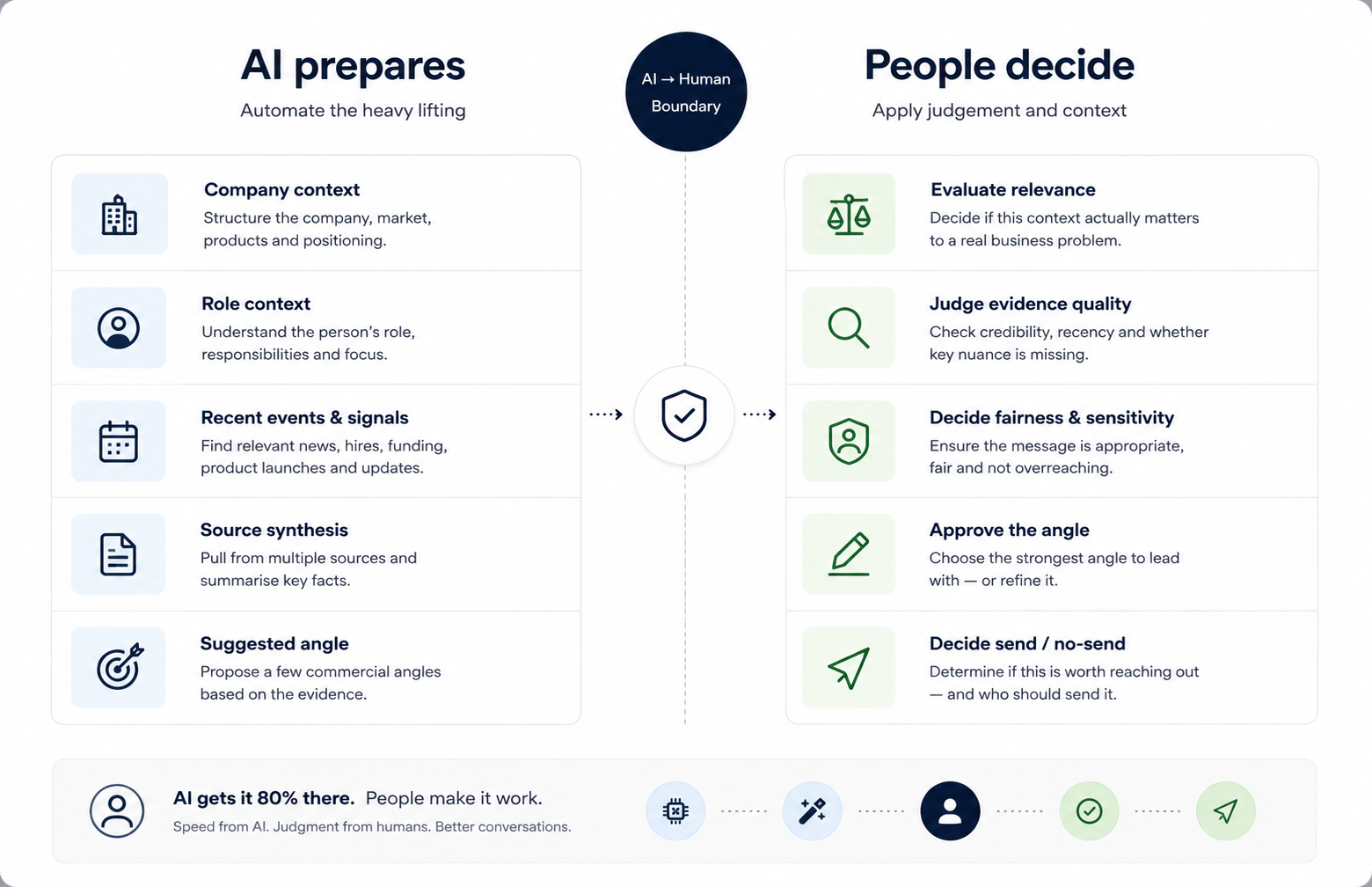
The real opportunity is more useful than that: automate the work that is repetitive, standardise the work that is inconsistent and keep human judgement exactly where getting the answer wrong changes the conversation.
“AI prepares. People decide and sell.
”
For sales leaders, that creates a much better question than "Can we automate prospect research?"
The question is: what should the automation actually be allowed to decide?
Prospect research automation is not the same as automated prospecting#
These two ideas are often bundled together, but they are not the same thing.
Automated prospecting can describe almost the entire outbound process: finding contacts, enriching data, prioritising leads, generating messages, enrolling people into sequences and handling follow-up tasks.
Prospect research automation is narrower. Its job is to remove the repetitive investigation between identifying a potential buyer and deciding what, if anything, makes that prospect worth contacting.
That distinction matters because research sits upstream of the message.
If the research is weak, automating the email does not repair it. It simply gives weak reasoning a subject line and a send button.
A good research process should establish enough reliable context to answer four commercial questions: why this company, why this person, why might now matter, and what does that change about the conversation?
Everything else is supporting evidence.
Five research jobs AI should take off an SDR's desk#
There is a lot of prospect research that does not become more valuable simply because a salesperson completed it manually.
The first opportunity is therefore not to automate judgement. It is to remove the repetitive work required before good judgement can happen.
| Research job | What automation should do | What the salesperson receives |
|---|---|---|
| Company context | Gather and structure relevant company information from approved sources | A concise account picture rather than disconnected tabs |
| Role context | Organise available role, seniority and responsibility information | A clearer view of why this person may matter |
| Recent events | Surface current hiring, leadership, expansion or other relevant changes where available | Evidence that may affect priority or timing |
| Information synthesis | Reduce multiple sources into the points relevant to the campaign | A usable brief rather than a company biography |
| First-pass angle | Connect available evidence to the approved value proposition | A hypothesis for the salesperson to accept, change or reject |
Those are good automation problems because the work repeats.
An SDR does not add much commercial value by manually copying a company description into their notes. They add far more value deciding whether the company change they found actually creates a credible reason to start a conversation.
That is the division of labour worth designing for.
The dangerous word is "therefore"#
Most bad automated prospect research does not fail when gathering the fact.
It fails in the sentence immediately afterwards.
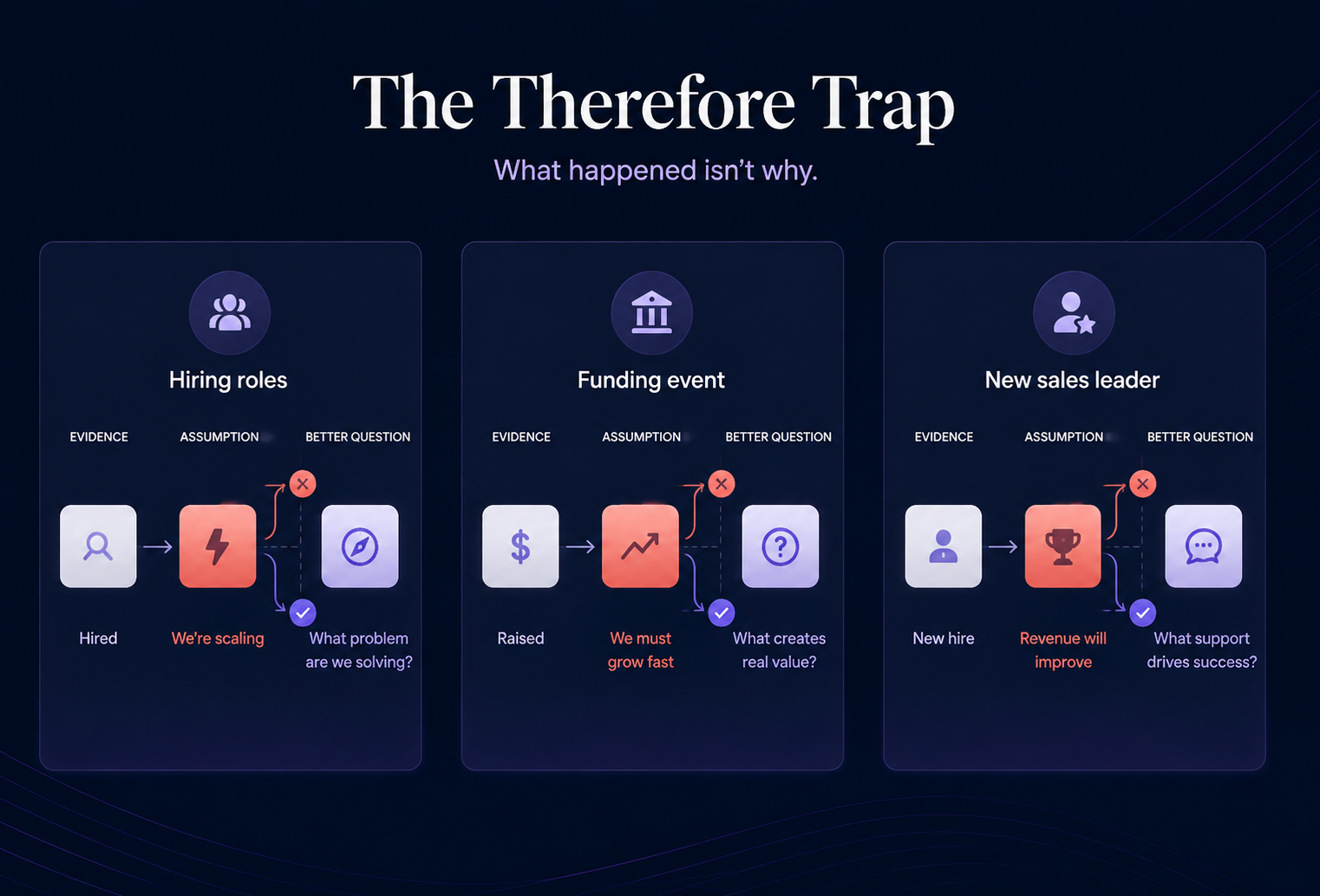
A company is hiring three SDRs, therefore its outbound process must be struggling. A business has raised funding, therefore it has budget for new software. A CRO joined recently, therefore the technology stack is about to be replaced.
The fact may be perfectly accurate. The conclusion can still be fiction.
This is where automation becomes psychologically persuasive. AI is very good at producing smooth explanations, and smooth explanations feel more certain than fragmented evidence. The risk is not always an obvious hallucination. It is a reasonable inference quietly losing the word "might".
For outbound, that difference is enormous.
"We noticed you're hiring several SDRs, so maintaining consistency must be difficult" tells the prospect what their problem is.
"We noticed the SDR hiring. Curious whether maintaining research and messaging consistency becomes more important as the team grows" uses the same evidence but leaves room for the buyer to tell you what is actually true.
The first is automation pretending to know.
The second is research helping a salesperson ask a better question.
Three decisions AI should not quietly make for you#
The easiest way to design sales research automation is to decide where the machine's authority should stop.
The first boundary is whether the evidence is strong enough to act on. Automation can surface the event, date and source, but somebody still needs to judge whether that evidence genuinely changes the priority of the prospect.
The second is whether the interpretation is fair. A signal can support a hypothesis without proving the underlying problem. The salesperson needs to be able to see the distance between what was observed and what the system concluded.
The third is whether the resulting message should represent the company. A draft can be grammatically excellent and commercially wrong. Brand, judgement, sensitivity and the quality of the proposed angle still matter when the message crosses from internal preparation into an actual buyer's inbox.
Those are not minor exceptions to automation.
They are the moments where research becomes selling.
The best research automation can say: "Nothing useful found"#
This may be the most underrated feature of a good automated research process.
Sometimes there is no compelling signal.
The prospect may fit the ICP. The person may have the right role. The company may be commercially relevant. But there is no recent event, public activity or meaningful contextual detail that deserves to become the opening line.
A weak system sees that as failure and keeps searching until it finds something.
Someone posted on LinkedIn six weeks ago. Someone attended a conference. The company redesigned its website. The prospect used to work somewhere interesting.
Eventually the AI has enough material to produce a "personalised" email that should never have been personalised in the first place.
A better system is allowed to stop.
This matters for SEO conversations about automated prospect research because the value is often framed as how much information the technology can uncover.
For sales teams, the more useful measure is how well it separates meaningful context from noise.
A B2B SaaS example: same evidence, very different research#
Imagine a fictional 60-person B2B SaaS company. It has a Head of Sales, an established SDR function and two new SDR roles advertised. The business has also announced that it is entering another English-speaking market.
There is enough there to research.
There is not enough there to diagnose the company.
| What we know | Weak automation concludes | Better research workflow |
|---|---|---|
| Two SDR roles are advertised | "They are struggling to scale outbound" | Sales capacity appears to be increasing |
| The company is entering a new market | "They need a new outbound platform" | Targeting and messaging requirements may be changing |
| A Head of Sales is in role | "They own this exact problem" | They are a plausible buyer; confirm the relevance |
| Two changes are happening together | "They are ready to buy now" | There is enough context to investigate and prioritise |
The difference is not that the better workflow is less intelligent.
It is that it is more disciplined.
The automation has still done useful work. It found the relevant company changes, structured the information and prepared a possible commercial connection. What it did not do is smuggle an assumption into the research and then ask the SDR to treat it as reality.
For a Head of Sales, that is the standard worth demanding from AI.
More research is not the goal#
There is a temptation to judge prospect research automation by volume.
How many sources did it search? How many attributes did it enrich? How many signals did it surface? How detailed is the final account brief?
None of those questions tells you whether the salesperson is better prepared.
A useful research brief can be surprisingly short. It needs enough company context to establish fit, enough person context to establish relevance, any current evidence that genuinely changes timing, a clear distinction between fact and inference, and a commercially credible suggested angle.
Then it should stop.
A 900-word account summary that leaves the SDR unsure what matters is worse than six lines that make the next decision obvious.
That is also why prospect research automation for SDRs should not become another administrative layer. If the rep has to read the equivalent of a miniature annual report before approving every prospect, the workflow has replaced tab-switching with AI-generated homework.
Automation should compress complexity.
It should not merely relocate it.
Build the workflow backwards from the decision#
If you are introducing prospect research automation into a B2B sales team, begin at the end.
Ask what decision the research is supposed to improve.
If the decision is whether the account deserves attention, the system needs reliable ICP and account context. If the decision is whether now is a better time to engage, it needs current evidence and a clear standard for interpreting signals. If the decision is what to say, it also needs the company's value proposition, proof, campaign objective and buyer context.
Only then should you decide what information the AI needs to collect.
That is the opposite of the common approach, where teams connect a large data source, generate as much research as possible and hope something commercially useful emerges.
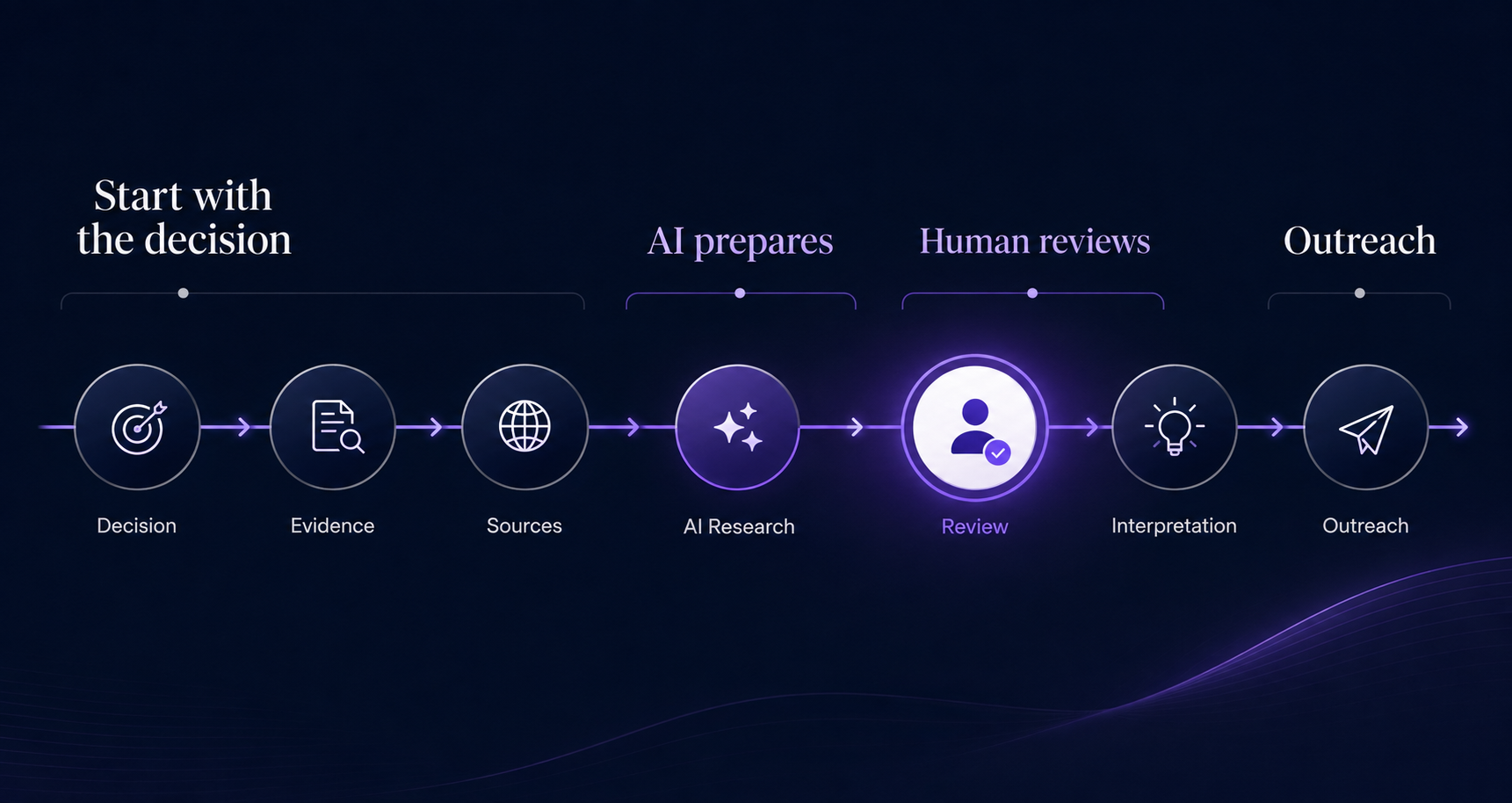
The process should look more like this:
Decision → required evidence → approved sources → AI preparation → confidence check → commercial interpretation → human review.
That gives the automation boundaries.
It also gives the salesperson something far more useful than a blank prompt.
Automate the research method, not one salesperson's habits#
There is another reason this matters as teams grow.
A founder or experienced salesperson often carries years of commercial pattern recognition in their head. They know which company changes matter, which signals are noise and which details are too weak to lead with. A new SDR does not automatically inherit that judgement when they receive a login and a target-account list.
The real opportunity in sales research automation is therefore not simply productivity.
It is codification.
The company can define what it considers useful evidence, which signals deserve investigation, how uncertainty should be expressed, which claims are acceptable and where a human must take over.
The technology can then apply that method repeatedly.
That is much more valuable than automating the browsing habits of whichever SDR happened to be performing best last quarter.
Where OREE fits#
OREE approaches prospect research as part of the wider journey from prospect intelligence to a sales conversation.
OREE can research and enrich prospects, structure available person and company context, identify relevant context and selected signals, and prepare contextual LinkedIn and email outreach inside a human-controlled workflow. A salesperson reviews the work before approved outreach represents the company.
The principle is deliberate: AI prepares. People decide and sell.
That does not mean keeping people trapped in every repetitive research task. It means using automation where repetition exists and keeping commercial judgement visible where the evidence needs interpretation.
For a lean B2B SaaS team, that distinction can be more useful than the promise of an autonomous salesperson.
The objective is not to remove the seller.
It is to stop wasting the seller on work a system can prepare.
Frequently asked questions about prospect research automation#
What is prospect research automation?#
Prospect research automation uses software and AI to gather, structure and interpret information about prospective customers before outbound engagement. It can include company research, role context, enrichment, recent events and the preparation of possible outreach angles.
The strongest workflows separate information gathering from commercial judgement so salespeople can see what was observed, what was inferred and what still needs verification.
Can prospect research be fully automated?#
Much of the repetitive preparation can be automated, but full automation is a different question. Research still contains decisions about evidence quality, relevance, inference and how confidently something should be used in customer-facing communication.
For many B2B teams, the more useful model is automated preparation with visible human judgement.
What is the difference between prospect research and data enrichment?#
Data enrichment adds information to a prospect record, such as company details, role information, email data or other available attributes.
Prospect research uses information to understand the commercial context. Its purpose is not simply to complete fields; it is to help decide why the prospect matters and what, if anything, is worth saying.
What should SDRs stop researching manually?#
SDRs should not need to repeatedly collect and organise basic company context, review the same categories of sources from scratch or manually reconstruct information that software can reliably prepare.
Their attention is better spent judging whether the evidence matters, challenging weak assumptions and deciding how the conversation should begin.
The question is not how much you can automate#
Most sales technology eventually gets judged by the same instinct: if a machine can do a task, perhaps the ultimate version is one where the human disappears completely.
Prospect research is a good example of why that logic breaks down.
The repetitive work should disappear. The unnecessary tab-switching should disappear. The constant copying, summarising and rebuilding of the same account context should disappear.
The judgement should get better.
That is the real standard for prospect research automation: does it simply make research happen faster, or does it leave the salesperson with a clearer, more credible reason to act?
OREE is built for the second model. If you want to see how prospect research can move from scattered preparation into a human-controlled outbound workflow, run one of your target prospects through OREE.
Better signals. Better conversations.
Written by
Kingsley Nnamonah
Head of Product
Builds the OREE product. Spent the last decade shipping AI tooling for revenue teams. Writes about the engineering and product decisions behind the co-pilot.


