
The first line is already written. That's the problem.
AI has found the company, summarised the website, pulled together the buyer's role, spotted a recent change and produced a neat paragraph explaining why this prospect should care. In less time than it would take an SDR to open the first few tabs, the research looks finished.
And that is exactly when somebody needs to look at it properly.
Because a beautifully written research summary can make weak information feel certain. An old funding announcement suddenly becomes a buying signal. A job advert becomes proof of a problem. A reasonable inference gets repeated in the email as though the prospect told us personally.
AI prospect research is extraordinarily useful when it removes the repetitive work behind outbound. It becomes dangerous when speed quietly turns assumptions into facts.
That is the distinction sales teams need to get right.
The question isn't whether AI can research prospects. It can. The more commercially important question is this:
What should AI be trusted to prepare, and what should a salesperson still be responsible for deciding?
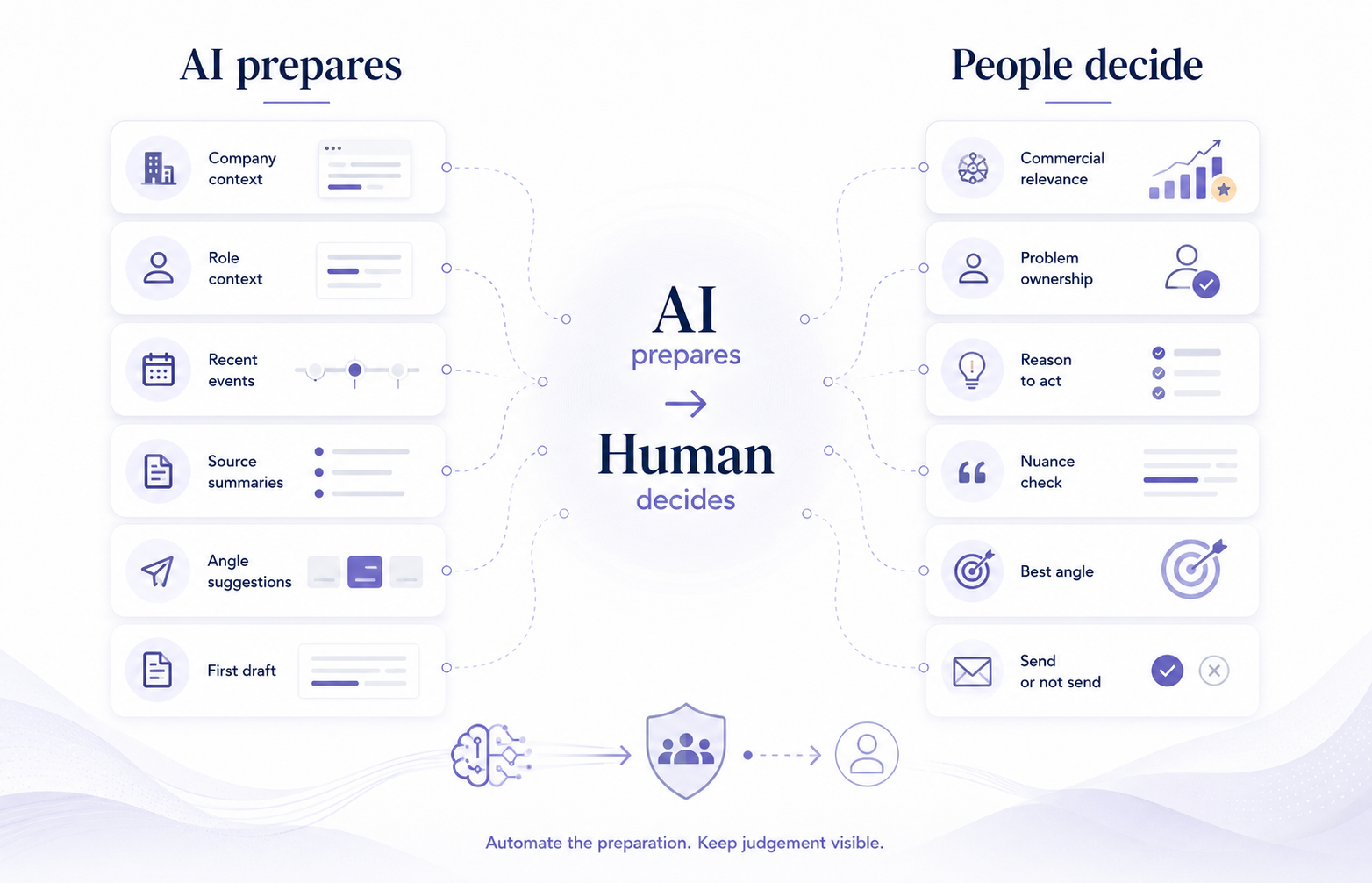
“AI prepares. People decide and sell.
”
That principle sounds simple. Applied properly, it changes the entire prospect research workflow.
AI prospect research has an information problem but an even bigger judgement problem#
Most outbound teams do not suffer from a shortage of information.
There are company websites, LinkedIn profiles, Sales Navigator, CRM records, funding announcements, hiring pages, industry publications, press releases, podcasts, social posts, product updates and databases full of firmographic information.
The problem is deciding which of those details actually matter.
A prospect mentioning AI on LinkedIn is information. A company advertising for three new SDRs is information. A business entering a new market is information. None of those facts automatically means the company needs what you sell.
That distinction gets lost surprisingly quickly.
An SDR under pressure to personalise an email can start treating research as a hunt for something — anything — distinctive enough to mention in the opening line. AI can make that hunt dramatically faster, but speed does not make the resulting observation commercially relevant.
A message can be deeply personalised and still have absolutely no reason to exist.
That is why the goal of AI prospect research should not be more information.
It should be better prepared judgement.
What is AI prospect research?#
AI prospect research is the use of artificial intelligence to gather, organise and interpret relevant information about a potential buyer and their company before sales outreach begins.
At its best, that means turning a messy collection of sources into a concise commercial brief. The AI can identify company information, role context, recent events, available signals and relevant market information, then organise those findings around the sales campaign being run.
But there are really three different jobs hidden inside that definition.
The first is collection: finding the information.
The second is interpretation: deciding what the information might mean.
The third is commercial judgement: deciding whether that interpretation is credible enough to change what the salesperson does.
AI is very good at the first job and increasingly useful at the second.
The third deserves more care.
Why traditional prospect research breaks as outbound grows#
Manual research works surprisingly well when the founder is doing the selling.
The founder usually understands the market, knows what a meaningful company change looks like and can tell the difference between an interesting fact and a real reason to start a conversation. They may not even think of what they are doing as "prospect research". They are simply looking at the account and making a judgement.
Then the outbound motion grows.
A BDR joins. Then another. Lists get bigger. Activity expectations increase. Research becomes a documented task rather than something that lives inside one person's commercial instinct.
That is where inconsistency appears.
One SDR checks LinkedIn. Another goes straight to the company website. One considers hiring activity meaningful. Another ignores it. Someone spends ten minutes reading company news. Someone else asks an AI model to summarise everything and accepts the first answer.
The team may be targeting the same market, but the research process is different for every salesperson.
AI creates an opportunity to standardise much of that work. Every account can be examined against the same research questions, the same campaign objective and the same evidence rules before a message is created.
But there is a catch.
When bad research is manual, it happens one prospect at a time. When bad research is automated, it scales beautifully.
That is why process matters more than the prompt.
What AI gets right in prospect research#
There are parts of prospect research that humans should be delighted to stop doing manually.
Not because the work is unimportant, but because the salesperson's judgement adds very little value to the mechanical part of completing it.
1. Gathering company context#
A salesperson rarely needs one isolated fact. They need a picture.
What does the company sell? Who does it serve? How large is the organisation? Where does it operate? Has anything material changed recently? Is the team hiring? Has the commercial leadership changed? Is the business entering a new market?
AI can gather and structure that information quickly.
The advantage is not merely speed. It creates consistency. Every prospect can begin with the same basic research standard rather than depending on what an individual SDR happened to remember to check.
2. Structuring information from different sources#
Real-world sales data is messy.
A company's own website may describe the business differently from LinkedIn. An old database entry may contain an outdated employee count. A prospect may have changed role while the CRM still shows their previous title.
AI can help normalise those inputs and show them in a consistent format.
That makes the salesperson's next decision easier because they are no longer assembling the account from fragments.
The important caveat is that conflicting information should remain visible. A clean answer is not useful if the AI achieved it by quietly choosing which source to believe.
3. Summarising information that does not deserve ten minutes of reading#
Salespeople do not need to read every company announcement, podcast transcript or product page word for word.
They need to know whether anything inside that information changes the commercial context.
This is one of the most natural jobs for AI. Long information can be reduced to the parts relevant to the campaign, while the original source remains available when something deserves closer inspection.
The quality of the result depends heavily on the question being asked.
"Summarise this company" creates information.
"Identify anything that materially changes how a sales leader selling this proposition should understand this account" creates a commercial research task.
Those are very different prompts because they begin with different intentions.
4. Surfacing potential signals#
Hiring, leadership changes, expansion, funding, product launches and other events can create a reason to examine a company more closely.
AI is particularly useful at making those events visible because the salesperson does not need to remember which sources to check manually for every prospect.
But the event itself is not the conclusion.
A company hiring SDRs does not automatically need outbound software. Funding does not mean someone has budget for your product. A new CRO does not guarantee that the technology stack is about to change.
The AI should surface the evidence.
The sales process should decide what that evidence means.
5. Preparing a first commercial hypothesis#
Once the context has been gathered, AI can help connect it to the seller's value proposition.
This is where the process becomes much more valuable than simple enrichment. Instead of handing the SDR a wall of facts, the system can suggest a reason the account may be worth contacting and an angle that might make sense.
The language matters here.
It is a suggested angle, not truth.
If the research finds that a company is advertising several SDR roles, the system might reasonably suggest that consistency, ramp-up or outbound capacity could become more relevant as the team grows.
It should not announce that the company is struggling with those problems.
That difference is small on the screen and enormous in an email.
AI can do the research. Your SDR still owns the conclusion.#
This is the division of labour that matters.
The objective should not be to keep humans involved in every step simply because humans used to perform every step. Equally, the objective should not be to remove people from decisions where commercial judgement changes the result.
| AI handles well | Your SDR should still judge | |---|---| | Gathering company context | Whether that context matters commercially | | Structuring role information | Whether this person really owns the problem | | Identifying recent events | Whether the event creates a reason to act | | Summarising multiple sources | Whether important nuance has disappeared | | Suggesting outreach angles | Which angle deserves to represent the company | | Preparing a first draft | Whether a real salesperson should send it |
That final column is where outbound stops being a data-processing exercise and becomes sales again.
An AI system can tell you that a company has hired a new VP Sales.
A salesperson should decide whether that fact is relevant to the conversation they are trying to start.
An AI system can find a public post.
A salesperson should decide whether referencing it feels genuinely relevant or uncomfortably performative.
An AI system can suggest a message.
A salesperson should remain responsible for whether that message represents the business properly.
Five things your SDR should always verify#
The danger with AI-generated research is not usually that it looks obviously bad.
It is that it looks polished enough to stop someone questioning it.
Before important research becomes part of an email, LinkedIn message or call opener, five things deserve a human check.
Is the information current?#
A fact can be accurate and still be commercially useless because the moment has passed.
An old job vacancy, leadership change or expansion announcement should not be presented as though it happened yesterday simply because it still appears in search results.
Freshness matters even more when a message is trying to create urgency.
The stronger your claim about why now, the stronger your evidence needs to be that "now" really means now.
Does the information actually change the conversation?#
Interesting information is everywhere.
Useful information is rarer.
A prospect may have attended an event, posted on LinkedIn or worked at a particular company before their current role. Those details can help someone understand the buyer, but they do not automatically belong in outreach.
Ask one question:
If this detail disappeared from the research, would we change what we say?
If the answer is no, the detail may not deserve to lead the message.
Are we looking at a fact or an interpretation?#
Imagine the research shows that a company is advertising three SDR roles.
"Three SDR positions are currently advertised" can be a fact.
"The business is struggling to scale its outbound process" is an interpretation.
That interpretation may be commercially sensible. It may also be completely wrong.
Good outbound does not need to pretend the second statement is certain.
A salesperson can use the first fact to ask an intelligent question about the second.
Does this person actually own the problem?#
Job titles are useful shortcuts, not perfect organisational charts.
One company may place outbound under a VP Sales. Another may place it with Growth. A founder may still run everything despite having a Head of Sales. Revenue Operations may influence the technology without owning the commercial motion.
AI can help identify likely responsibility.
The salesperson should still ask whether the person being contacted has a plausible reason to care.
The right company and wrong person is still the wrong prospect.
Would you be comfortable saying this face-to-face?#
This catches more bad personalisation than most elaborate scoring models.
If a detail feels intrusive, speculative or oddly personal when you imagine saying it directly to the prospect on a call, think carefully before placing it into an automated message.
Good research should make the salesperson better prepared.
It should not make the buyer wonder why a stranger has been studying them.
Facts, interpretations and guesses should not look the same#
AI has a language problem.
It can express weak evidence with exactly the same confidence as strong evidence.
"The company is expanding its commercial team" and "the company appears to be expanding its commercial team" are only one word apart, but that word carries the difference between observation and interpretation.
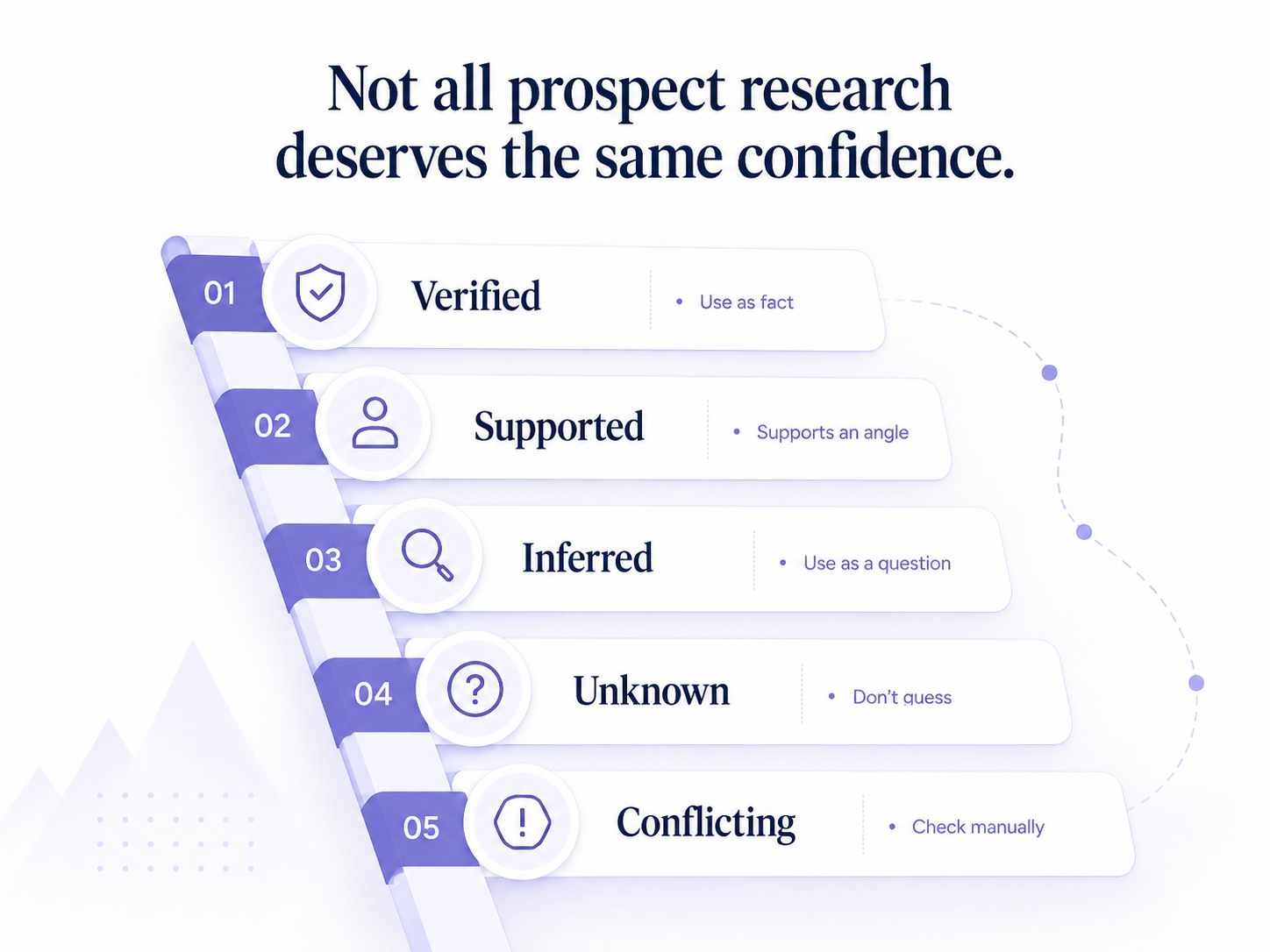
A useful AI prospect research process should therefore make confidence visible.
| Confidence | What it means | How sales should use it |
|---|---|---|
| Verified | Confirmed through a current, attributable source | Can be used carefully as a fact |
| Supported | Several credible details point in the same direction | Can support an angle without claiming certainty |
| Inferred | Reasonable interpretation from incomplete evidence | Use as a hypothesis or question |
| Unknown | Reliable information is missing | Do not manufacture personalisation |
| Conflicting | Sources disagree or appear outdated | Check manually or avoid the contested point |
This is not simply about avoiding embarrassing mistakes.
It makes the message better.
Compare these two approaches.
The first says:
"I can see you're scaling your outbound team, so maintaining message quality must be becoming difficult."
The second recognises what is known and what is not:
"I noticed the SDR hiring alongside the move into the new market. Curious how you're thinking about keeping research and messaging consistent as the team grows?"
The second message gives the prospect room to correct the assumption.
That is not weaker selling.
It is more credible selling.
A good prospect brief is shorter than you think#
One of the easiest mistakes with AI is asking it to produce everything it can find.
That usually creates the research equivalent of a badly run discovery call: a lot of information and very little clarity.
An SDR does not need a biography.
They need enough context to answer a small group of questions quickly.
Who is this company? Is it genuinely within the audience the campaign is designed for?
Who is this person? What does their role suggest about their responsibility and influence?
What has changed? Is there anything current that might alter priority or timing?
What do we actually know? Which pieces of information are verified, supported or inferred?
Why could our proposition be relevant? What connects the evidence to a real problem we solve?
What should we say? What is the strongest credible angle, and what should we avoid claiming?
A research brief that answers those questions is useful even when it only contains a few paragraphs.
A research brief containing twenty facts but no commercial judgement is just another tab.
What this looks like for a B2B SaaS sales team#
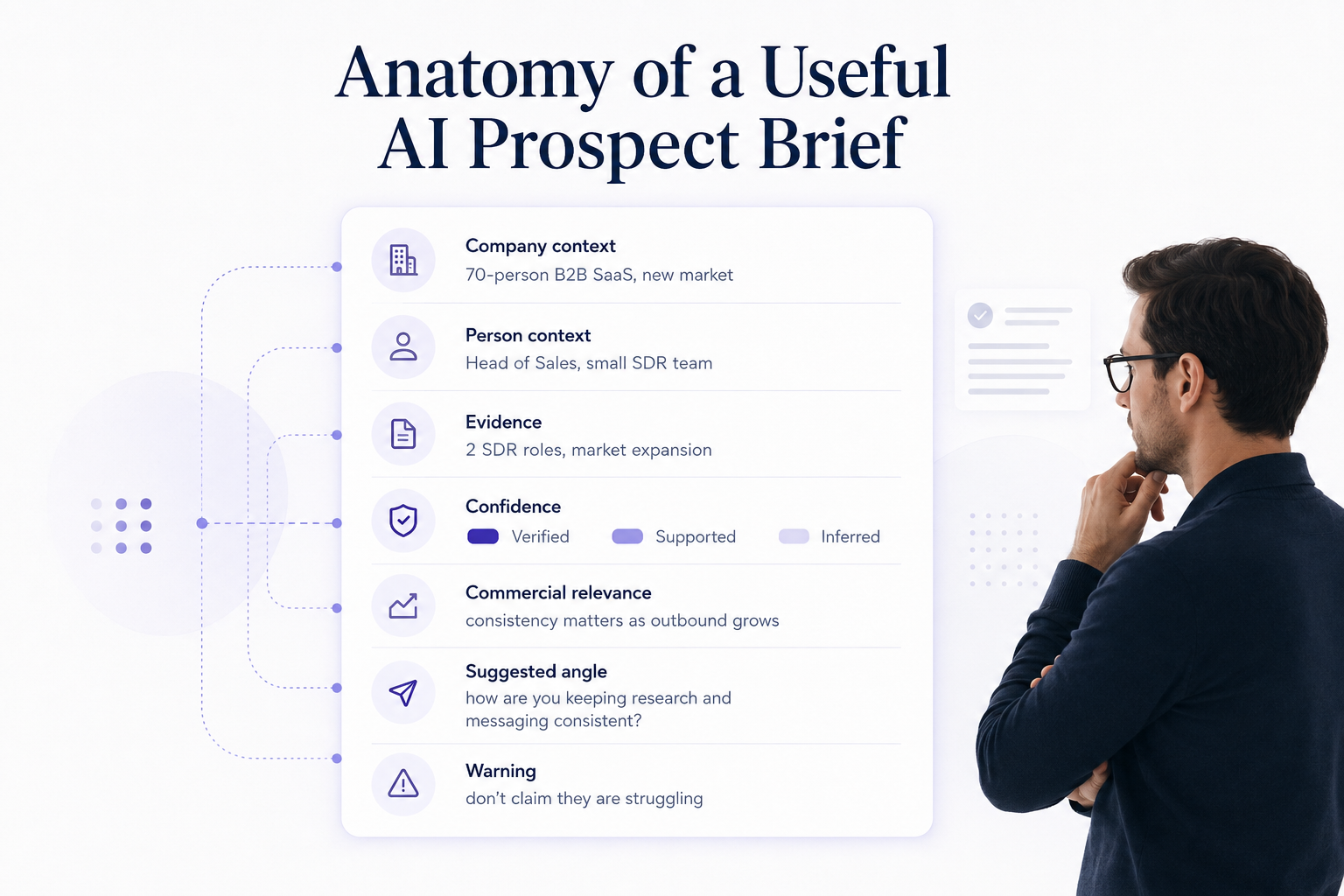
Consider a hypothetical 70-person B2B SaaS company.
The company fits the campaign ICP. A Head of Sales is in role. Public information shows two SDR positions being advertised and a recent announcement about expansion into another market.
An AI system can collect those facts easily.
A weak research process then makes the leap:
"The company is rapidly scaling outbound and struggling to maintain quality."
It sounds plausible.
It is also pretending to know something the research never established.
A better process separates the layers.
The observed evidence is the SDR recruitment and market expansion.
The supported interpretation is that the company may be increasing or changing its outbound capacity.
The commercial hypothesis is that consistency in prospect research and messaging could become more important as more people participate in outbound.
Now the salesperson has something useful.
Not a fabricated pain point.
A credible question.
That changes how the outreach sounds.
Instead of telling the Head of Sales what their problem is, the message can acknowledge the observable change and explore whether the resulting operational challenge exists.
The research has done its job.
It has not written a clever first line.
It has given the salesperson a better reason to start a conversation.
Where AI prospect research usually goes wrong#
The first failure is false confidence.
AI writes smoothly. When evidence is weak, that fluency can disguise uncertainty rather than remove it. If sources and confidence are hidden, the SDR may never know which statements were observed and which were inferred.
The second failure is research without purpose.
A system can collect twenty facts because twenty facts exist. Unless the campaign defines what it is looking for, the result is information accumulation rather than prospect intelligence.
The third is personalisation theatre.
Someone finds a post, a podcast or an unusual detail and forces it into the email because the message now looks "researched". The recipient can often feel the difference between genuine relevance and a reference included purely to demonstrate effort.
The fourth is weak commercial context.
AI cannot reliably connect prospect evidence to the right sales angle if it does not understand the offer, target audience, approved proof and customer problem. A better model cannot compensate for an undefined proposition.
The fifth is an inability to say no.
Some prospects fit the ICP but do not have an obvious signal. Some research is conflicting. Some potential angles are too weak to justify.
The system should be comfortable saying so.
That restraint is a sign of quality, not failure.
Stop trying to fix a process problem with a better prompt#
Prompt engineering matters.
It just happens much later than most teams think.
Before writing the prompt, someone needs to define what counts as good prospect research.
Which companies qualify?
Which roles matter?
Which information sources should be trusted?
Which signals deserve attention?
How fresh does information need to be?
Which claims can be used in outreach?
How should uncertainty be expressed?
What should happen when no meaningful context exists?
Who decides whether the final angle is good enough?
Without those rules, AI does not automate your research process.
It automates everyone's personal interpretation of what research should be.
That is why two SDRs can use the same AI model and still produce radically different outbound.
The model is only one part of the system.
The commercial standard around it matters more.
What should change for the SDR?#
The goal should not be to remove the SDR from prospect research.
It should be to move their attention to the part of the research where they are useful.
An SDR does not create much commercial value by copying a company description from one system into another. They create considerably more value deciding whether a recent event changes the reason to engage.
They do not need to spend working time producing a summary from scratch if AI can prepare one accurately.
They do need to question whether that summary supports the angle being proposed.
This changes the work.
The salesperson becomes less responsible for finding every individual piece of information and more responsible for determining what deserves to become part of the conversation.
That is a better use of sales judgement.
It is also the difference between automating research and automating thinking.
The research should survive the first message#
There is another problem that gets less attention.
A team can perform excellent prospect research and then immediately lose it.
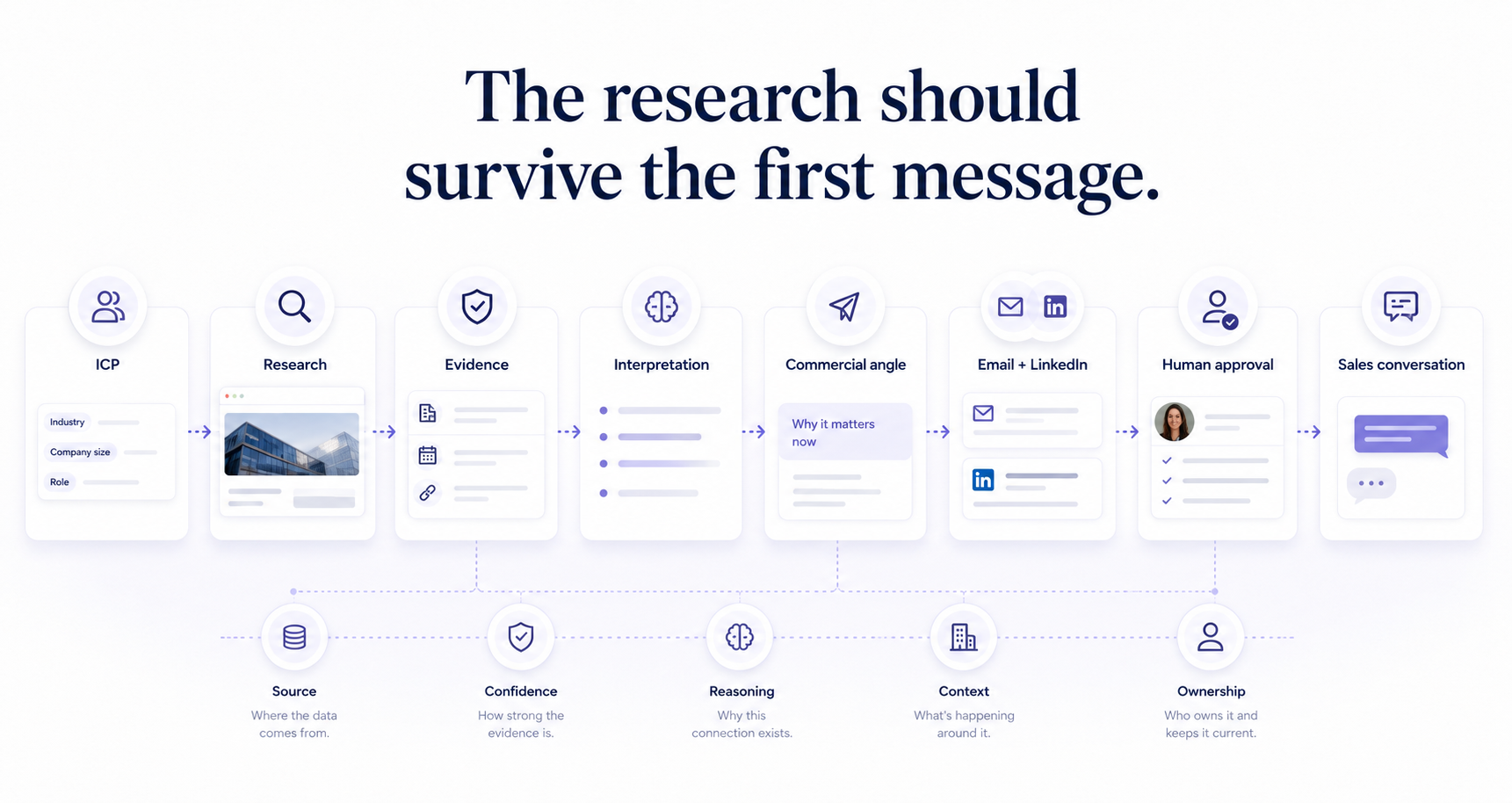
The research sits in one tool. The email is written in another. LinkedIn runs somewhere else. The CRM contains a few basic fields. When the prospect replies, the salesperson handling the conversation has to reconstruct why the company was approached in the first place.
Good prospect research should survive the workflow.
The reason the prospect was selected, the evidence behind the angle, the relevant company context and the assumptions that were made should remain available when the salesperson needs them.
Otherwise the research only improved the first message.
It did not improve the sales conversation.
Where OREE fits into AI prospect research#
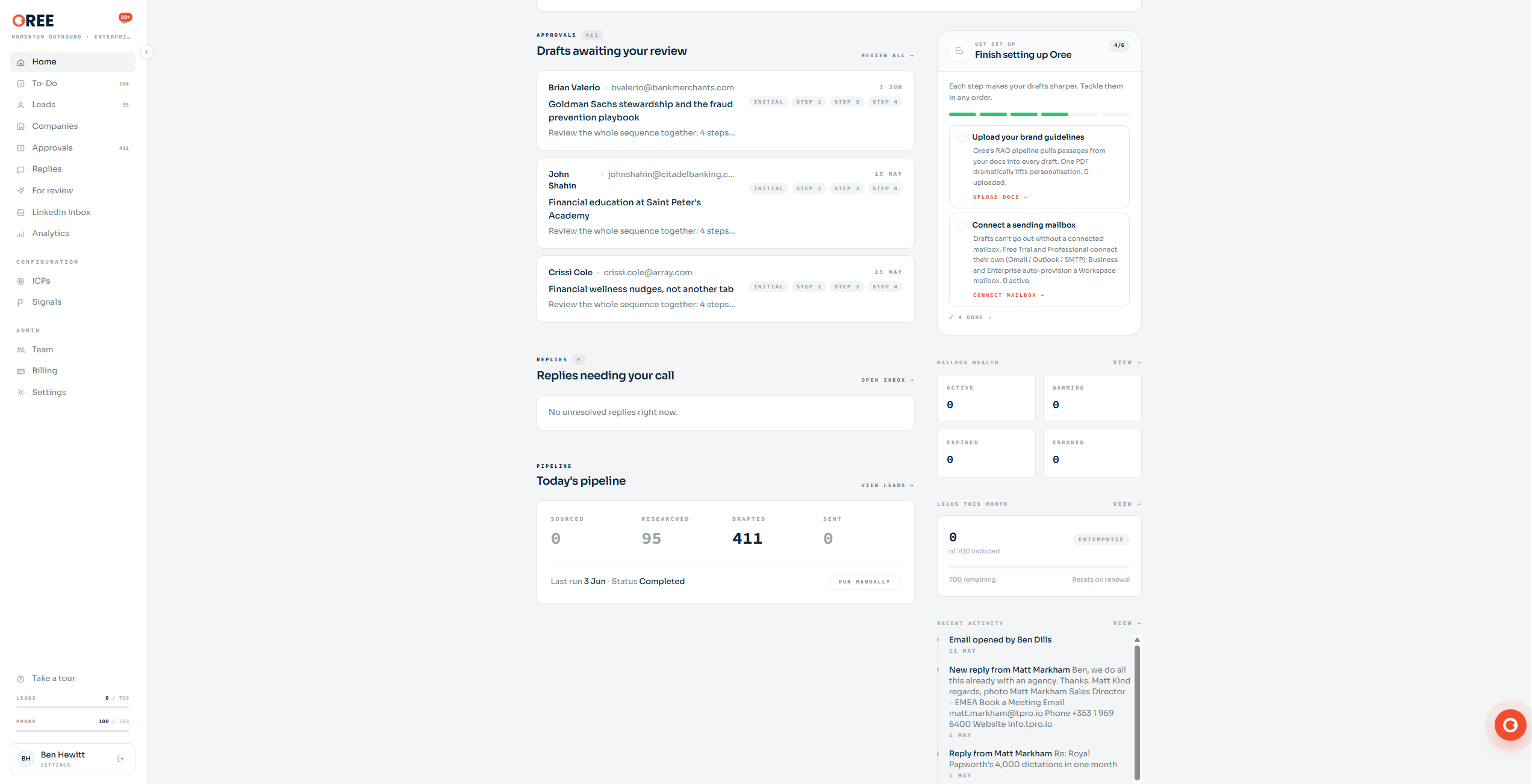
OREE is an AI-assisted outbound sales platform built around the work between identifying a prospect and starting a useful sales conversation.
The platform can research and enrich prospects, structure available person and company context, identify selected signals, prepare contextual email and LinkedIn outreach and place the message in front of a person for review before it represents the business.
That human control is deliberate.
OREE is not built around the assumption that the most advanced version of AI sales is the one where nobody looks at what the AI is doing.
The objective is to remove repetitive preparation while keeping commercial judgement visible.
Why this prospect? Why now? What do we actually know? What should we say?
Those are the questions AI prospect research should help a salesperson answer.
Not replace.
Frequently asked questions about AI prospect research#
What is AI prospect research?#
AI prospect research uses artificial intelligence to gather, organise and interpret available information about a potential customer before sales outreach. It can reduce repetitive research work while giving the salesperson a structured view of the company, buyer and relevant context.
The important distinction is that an AI-generated summary is still an input into a sales decision. Important information should be current, relevant and appropriately verified before it becomes customer-facing outreach.
Can AI completely automate prospect research?#
A large amount of research preparation can be automated, including gathering information, structuring account context, identifying potential events and summarising sources.
The harder question is whether AI should make every commercial interpretation independently. Relevance, inference, sensitivity and the final reason to contact a prospect still benefit from human judgement.
What should an SDR verify in AI-generated research?#
The SDR should verify important facts, the freshness of time-sensitive information, whether the person appears relevant to the issue and whether an apparent signal genuinely connects to the campaign.
They should also distinguish clearly between what has been observed and what the AI has inferred from that evidence.
Is AI prospect research the same as data enrichment?#
No.
Enrichment adds or completes data such as job title, company information, contact details or firmographic attributes.
Prospect research goes further. It tries to understand the commercial context around the company and person, identify what may be relevant and prepare the information needed to make a better outreach decision.
Does more prospect research create better outbound?#
Not automatically.
The objective is not to collect the maximum amount of information about someone. It is to gather enough reliable context to decide whether to contact them, why the timing makes sense and what is worth saying.
Research that changes none of those decisions may simply be noise.
How should a sales team start using AI for prospect research?#
Start by defining the research process before selecting the automation.
Agree the ICP, campaign objective, information sources, evidence rules, relevant signals, confidence levels and the decisions that should remain human. AI can then execute a consistent research method rather than improvising a new one for every lead.
The real test is not how much research AI can do#
AI will continue to get faster at finding, summarising and interpreting information.
That part is inevitable.
The more useful question for a sales leader is whether the technology leaves the salesperson better prepared to have a conversation.
If the SDR receives more data but still has no idea why the prospect matters, the research has failed.
If the AI produces a polished message by quietly converting assumptions into certainty, the research has failed.
If the system removes repetitive work, keeps the evidence visible and gives the salesperson a credible reason to engage, the technology has done something much more valuable.
It has not replaced sales judgement.
It has given that judgement something better to work with.
OREE is built around that division of labour: AI prepares. People decide and sell. If your team is still assembling prospect context manually before every meaningful piece of outreach, you can see how OREE works or run a target prospect through the workflow.
Written by
Kingsley Nnamonah
Head of Product
Builds the OREE product. Spent the last decade shipping AI tooling for revenue teams. Writes about the engineering and product decisions behind the co-pilot.


